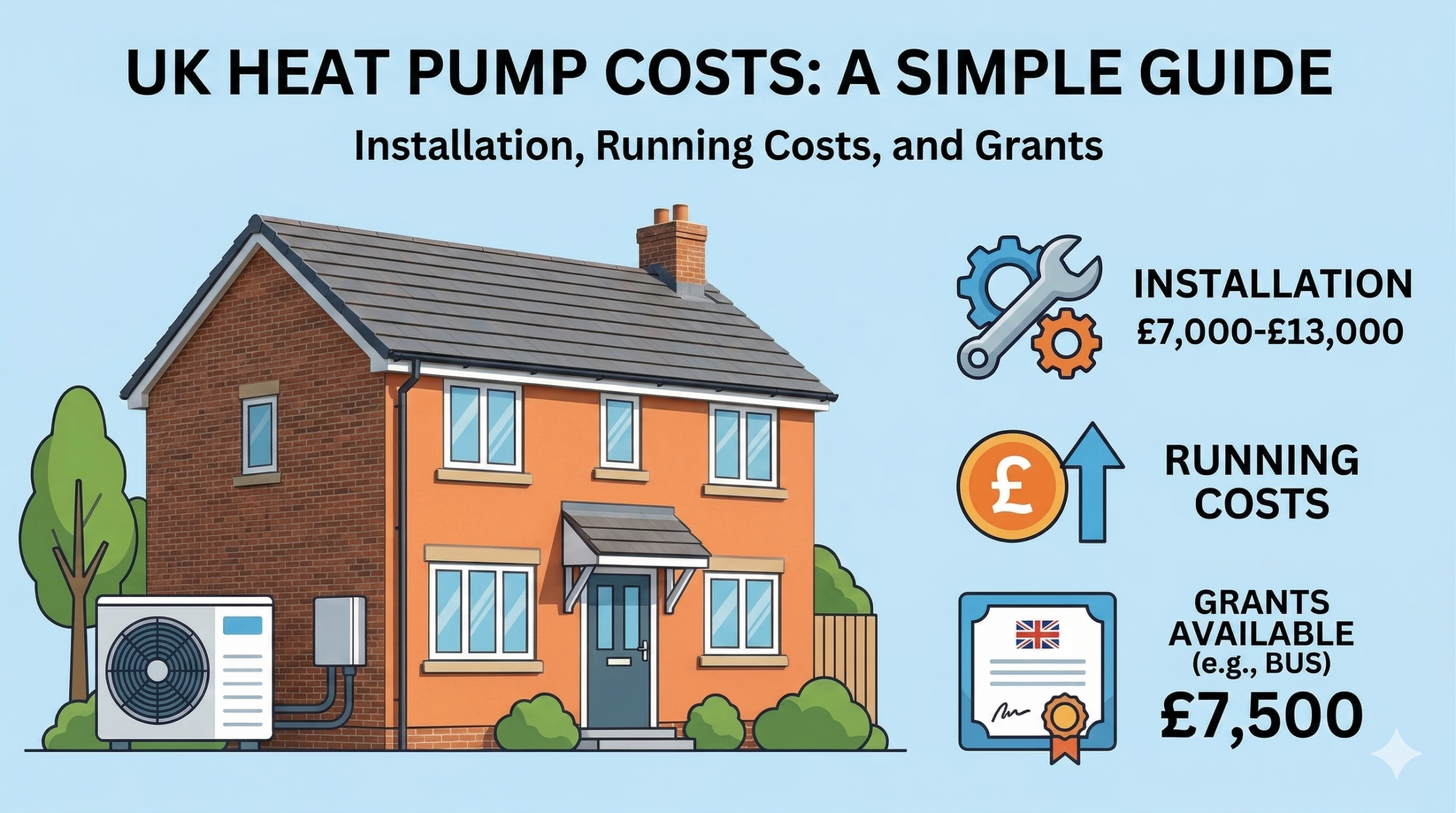

Short answer: around £12,500 on average before any grant, according to the latest government Boiler Upgrade Scheme figures. After the £7,500 BUS grant, most homeowners pay somewhere between £3,500 and £6,000. Some smaller properties pay less.
Longer answer: it depends on your house, your insulation, your existing radiators, and what the survey turns up. The headline number is a starting point, not a quote.
This guide goes through the real numbers, by property size, by what is and is not included, by what adds cost that most installers do not volunteer upfront. There is a West Midlands section near the end with figures specific to Birmingham, Worcester, and the surrounding towns.
2026 cost summary
- Average installed cost before grant: £12,500 (BUS statistics, July 2025)
- After £7,500 BUS grant: typically £3,500 to £6,000
- 0% VAT saves a further £500 to £900 — applies automatically until March 2027
- Annual running costs: £800 to £1,100 for a 3-bed at current Ofgem rates
- Installation: 2 to 3 days for most homes
- Payback period: 7 to 15 years — shorter if replacing oil, LPG or electric heating
What you pay by property size
System size drives most of the price difference. A small flat needs a 5 kW unit. A large detached house might need 14 or 16 kW. That is not just a bigger box, it is more pipework, longer install time, and a higher unit price.
These figures cover the heat pump unit, labour, hot water cylinder, standard pipework, and commissioning. Radiator upgrades, electrical work, and other extras are separate, that list comes next.
| Property | System | Cost before grant | After £7,500 BUS grant | VAT saving (0%) |
| 1 to 2 bed flat/house | 5 to 7 kW | £7,000 to £10,000 | £0 to £2,500 | ~£350 to £500 |
| 2 to 3 bed semi/terrace | 7 to 10 kW | £9,000 to £12,500 | £1,500 to £5,000 | ~£450 to £625 |
| 3 to 4 bed detached | 10 to 13 kW | £11,000 to £15,000 | £3,500 to £7,500 | ~£550 to £750 |
| 4 to 5 bed large property | 13 to 16 kW | £14,000 to £18,000 | £6,500 to £10,500 | ~£700 to £900 |
VAT saving calculated at 0% versus 5% standard rate. Relief confirmed until 31 March 2027. Source: HMRC.
What Wunergy’s price includes
Every installation covers:
- Heat pump unit, sized from a heat loss calculation on your property
- Labour over two to three days, two engineers on site
- Hot water cylinder, or connection to an existing suitable one
- Pipework between outdoor unit and indoor heating system
- Electrical connections to the outdoor unit
- Smart heating controls and thermostat
- Full commissioning, testing, and handover
- MCS certification paperwork for the Boiler Upgrade Scheme
- BUS grant application, we submit this on your behalf
What is not in that list depends on the property. Older houses usually need more.
The extras that catch people out
Comparison websites quote national averages. They do not show you what a surveyor finds when they actually walk around your house. These are the most common additions:
| What | Typical cost | When it applies |
| Radiator upgrade (per radiator) | £150 to £400 | Older or undersized rads |
| New hot water cylinder | £400 to £900 | No cylinder, or current too small |
| Consumer unit upgrade | £500 to £1,000 | Old electrics that cannot handle load |
| Scaffolding | £300 to £600 | Unit needs to go high on a wall |
| Pipework changes | £200 to £800 | Narrow-bore or complex existing pipework |
| Smart controls/thermostat | £150 to £400 | Recommended on all installs |
| Annual service | £150 to £300/yr | Every year, keeps warranty valid |
Watch this when comparing quotes
A quote of £8,000 that excludes three radiator upgrades and a new cylinder is not cheaper than a £9,500 quote that includes them. Always ask what is and is not in the price. Wunergy provides a fully itemised quote after the free survey so nothing comes as a surprise later.
Why some jobs cost more than others
Insulation and heat loss
Before any system gets designed, a heat loss calculation works out how much heat your home bleeds on a cold day. Poor insulation means the number is higher, which means a bigger system.
A well-insulated three-bed semi typically needs an 8 kW unit. The same house with no loft insulation and single glazing might need 12 kW. That is a difference of roughly £2,000 to £3,000 in unit cost before labour is touched.
Radiators
Gas boilers push water at 60 to 70 degrees. Heat pumps run at 35 to 50 degrees. Lower flow temperatures mean older radiators often do not give off enough heat, they were sized for the hotter system.
Replacing undersized radiators is one of the most common additional costs. Budget £150 to £400 per radiator. A three-bed house typically has seven to nine. Do that maths before dismissing the upgrade.
Existing pipework and electrics
Narrow-bore pipework in older properties sometimes needs replacing before a heat pump can circulate water properly. Outdated consumer units occasionally need upgrading to handle the additional load. Neither is guaranteed, but both get flagged during a proper survey.
Where the unit goes
Most outdoor units go on a wall bracket or a small ground pad. Straightforward. But if the best location for airflow means scaffold access or a longer pipe run through the building, that adds to the job.
Brand and spec
Wunergy fits Samsung units with an ErP A+++ rating. That is the top efficiency band and a requirement to access the Boiler Upgrade Scheme grant. Budget brands exist. Some perform fine. Some do not. The difference shows up in the bills every winter and in how easy it is to get parts if something needs fixing in year eight.
Running costs once it is in
Electricity is more expensive per unit than gas. That is just the current reality. Ofgem’s April to June 2026 average rates: 24.67p per kWh for electricity, 5.74p per kWh for gas.
What changes the picture is efficiency. A heat pump with a COP of 3.0 produces 3 kWh of heat from every 1 kWh of electricity. At 24.67p input, that works out at about 8.2p per kWh of useful heat. A gas boiler at 90 percent efficiency delivers heat at roughly 6.4p per kWh. The gap is smaller than it looks.
And it disappears entirely if you are comparing against oil, LPG or electric heating.
| Heating system | Annual running cost | vs heat pump |
| Air source heat pump (COP 3.0) | £800 to £1,100 | Baseline |
| Gas boiler, A-rated new | £900 to £1,300 | Similar or slightly more |
| Oil boiler | £1,400 to £2,000 | 40 to 80% more |
| LPG boiler | £1,600 to £2,200 | 60 to 100% more |
| Electric storage heaters | £2,200 to £3,000 | More than double |
Estimates use Ofgem April to June 2026 price cap and average heating consumption for a 3-bed semi. Real costs vary with insulation quality, system design, and how the thermostat is used.
The £7,500 grant: who gets it
The Boiler Upgrade Scheme pays £7,500 directly to the installer for eligible air source heat pump installations in England and Wales. It comes straight off your bill. You do not see the money or apply for it yourself.
Six things to check:
- England or Wales. Scotland has Home Energy Scotland. Northern Ireland has separate arrangements.
- Existing fossil fuel system. Gas, oil, LPG, or electric heating. Replacing an existing heat pump does not qualify.
- Valid EPC. Needed, but since May 2024 you no longer have to fix outstanding insulation recommendations first.
- MCS certified installer. Wunergy is MCS certified. We submit the application.
- Not a developer-owned new build. Finished new builds with existing fossil fuel systems can qualify.
- One per property. No announced end date, but the scheme runs while funding lasts.
0% VAT: nobody mentions this enough
Heat pump installations are zero-rated for VAT in the UK until 31 March 2027. On a £12,000 job, that is around £600 saved compared to the 5% rate that applied before. It applies automatically. Nothing to claim, nothing to register for.
When you are comparing quotes, make sure VAT is shown consistently. Some installers quote ex-VAT, some include it. On a job this size the difference is not small.
West Midlands: what local jobs actually cost
National averages come from a mix of London, the South East, and rural Scotland. They do not always reflect what a Birmingham or Worcester installer quotes.
From Wunergy’s installations across the West Midlands:
- 2 to 3 bed terraced or semi: £9,000 to £12,500 before grant
- 3 to 4 bed detached: £11,500 to £15,000 before grant
- Older properties with radiator upgrades needed: add £1,500 to £3,500
- After the £7,500 BUS grant: most local homeowners pay £2,000 to £7,000
Labour rates across Birmingham, Bromsgrove, Redditch, Stratford-upon-Avon and Worcester are broadly in line with the national average. The condition of the existing heating system is where local jobs vary most. Properties built after 2000 usually need fewer extras and land at the lower end of the range.
Is it actually worth switching?
Oil, LPG, or electric storage heaters: yes, for almost every property. The saving is real and the payback comes faster than most people expect.
Mains gas with a recent A-rated boiler: more complicated. Gas is still cheaper per unit than electricity. If the boiler is less than five years old and the home is well insulated, the financial case takes longer to build. The argument shifts if you factor in the 2035 gas boiler phase-out, rising fossil fuel prices, or the fact that you plan to stay in the house for twenty years.
One thing worth saying plainly: a Green Britain Foundation survey from January 2026 found 66 percent of heat pump owners reported their homes cost more to heat than before. That figure gets shared a lot without the context. Most of those installations involved poorly insulated homes, undersized radiators, or systems that were not sized or commissioned properly. A system that is correctly designed for the property performs very differently. Bad installs exist. They are not representative of the technology.
If a free survey at your property suggests the numbers do not stack up, Wunergy will say so rather than proceed anyway.
Questions about cost
Can I get one installed for free?
Not through the Boiler Upgrade Scheme. That is a £7,500 contribution, not full funding. If you are on a low income, the Warm Homes Local Grant can cover the full cost of energy improvements including heat pump installation for eligible households in England. Worth asking about at the survey stage.
How long before it pays for itself?
The HomeOwners Alliance puts the range at 7 to 15 years. The lower end applies when replacing oil or LPG in a well-insulated house. The upper end is more typical when replacing a recent gas boiler. Either way, the system lasts 20 to 25 years, so payback happens well within its working life for most properties.
Does system size change the cost much?
Yes, noticeably. The gap between a 7 kW and a 12 kW unit is roughly £1,500 to £2,500 in hardware alone, plus more labour. Oversizing wastes money on the install and on running costs. Undersizing means the system struggles in winter. Wunergy does a heat loss calculation before recommending anything.
Any other funding worth knowing about?
ECO4 runs until December 2026 and helps low-income households with energy efficiency upgrades. Barclays and some other mortgage lenders offer cashback of up to £1,000 for heat pump installation through green home reward schemes. Check whether your lender runs one. Wunergy flags relevant funding options during the survey.
What if I sell the house before it pays back?
The system transfers with the property. It improves the EPC rating, which buyers increasingly check. A good EPC rating has a measurable effect on asking price, particularly as the gas boiler phase-out gets closer. You will not recover every pound spent, but it is not a write-off either.
Book a free survey and get a full itemised quote
Wunergy installs MCS-certified air source heat pumps across Birmingham, Worcester, Bromsgrove, Redditch and the wider West Midlands. The survey includes a heat loss calculation, a full itemised quote, and a BUS grant eligibility check. No obligation.
Book here: wunergy.co.uk/get-a-quote