
Air source heat pump problems: what is wrong and how to fix it
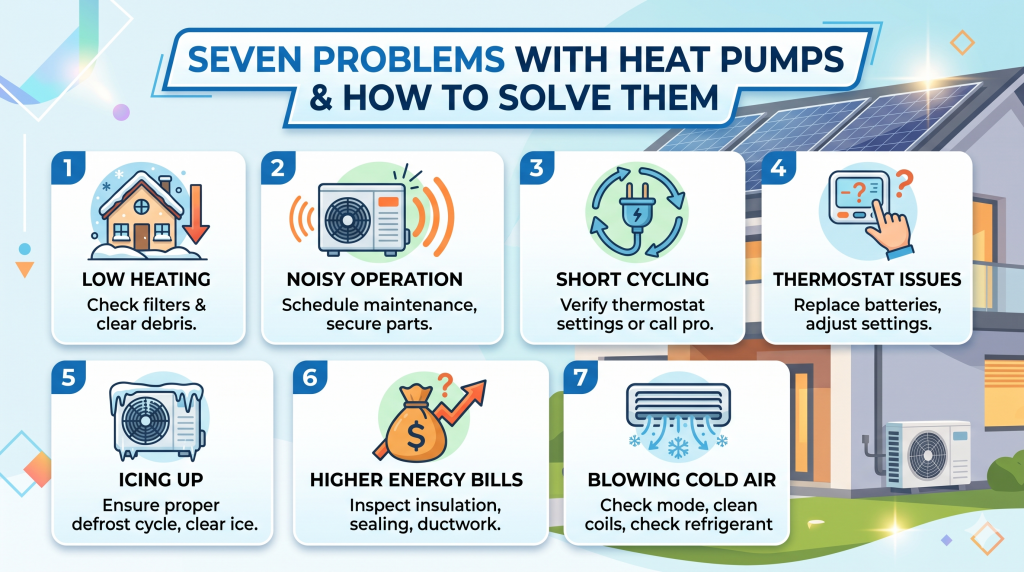
Something has gone wrong with your heat pump. The house is not warming up, or the outdoor unit is making a noise you have not heard before, or the radiators feel barely warm. You need answers quickly. Most heat pump faults fall into a small number of categories. Some you can sort yourself in five minutes. Others need a qualified engineer. This guide goes through each problem plainly, tells you what to check before calling anyone, what repair costs look like in 2026, and when it makes more sense to replace the system rather than fix it. Before anything else: the quick checks Run through these before assuming there is a serious fault. A surprising number of call-outs turn out to be one of these: If none of those fix it, read on. Problem 1: the heat pump is not heating the house This is the most common complaint, especially during cold weather. The system is running, you can hear it, but the house is not warming up properly. Radiators feel lukewarm rather than hot This is not necessarily a fault. Heat pumps run at lower flow temperatures than gas boilers, typically 35 to 50 degrees rather than 65 to 75. Radiators will feel warm to the touch rather than hot. As long as the rooms are reaching the set temperature, the system is working as designed. If rooms are not reaching temperature and it is taking much longer than usual, the likely causes are: The heat pump turns on but nothing happens Check the thermostat first. If that is fine, check the breaker. If the unit is completely silent with no lights on the controller, there is likely a power supply issue. Call an engineer. If the unit starts and the outdoor fan runs but there is still no heat output, the refrigerant may be low. You will sometimes hear a hissing sound near the outdoor unit. That is a refrigerant leak. Do not continue running the system and call a qualified F-Gas engineer. The reversing valve is stuck If the system heats in summer (cooling mode) but will not heat in winter, or vice versa, the reversing valve is the likely culprit. This valve switches the direction of refrigerant flow to change between heating and cooling modes. When it sticks, the system runs in the wrong mode. A stuck reversing valve needs a professional. It is not a DIY repair. Problem 2: the outdoor unit is icing up Some frost on the outdoor unit in winter is completely normal. The system enters a defrost cycle periodically — you may hear it switch modes briefly, and the unit may produce a little steam. That is fine. Ice that does not clear after a defrost cycle, or heavy ice building up on the coils, is a problem. Possible causes: Do not attempt to chip or melt ice from the outdoor unit with hot water. This can cause damage. If the ice is not clearing after a defrost cycle, switch the system off and call an engineer. Problem 3: the heat pump is running constantly Heat pumps run differently from gas boilers. A boiler fires up, heats the water quickly, and shuts off. A heat pump runs longer at lower output. Longer run times are normal and actually more efficient than short cycles. Constant running becomes a problem when the house still is not reaching temperature despite the system never switching off. Common reasons: If it is just a cold day and the system is running more than usual, that is expected behaviour. If it never stops even in mild weather and rooms are still cold, get it checked. Problem 4: strange noises Heat pumps make some noise, the outdoor fan, compressor hum, and the occasional click or gurgle during defrost or startup are all normal. New or unusually loud sounds are worth paying attention to. Rattling or vibrating Usually means something is loose. Check that the outdoor unit is still sitting level on its pad and that the fixings are secure. A loose panel or mounting bracket vibrates against the unit casing. If tightening everything does not stop it, the noise is coming from inside and needs an engineer. Grinding or shrieking Switch the system off immediately. This usually indicates a problem with the fan motor or compressor. Running it further risks causing more damage. Call an engineer. Hissing or gurgling Gurgling can mean low refrigerant. Hissing almost always means a refrigerant leak. Turn the system off and call an F-Gas certified engineer. Refrigerant is under pressure and potentially toxic, this is not something to investigate yourself. Clicking that will not stop A single click at startup and shutdown is normal. Repeated clicking when the system is trying to start can indicate a faulty starter capacitor or contactor. Both need a professional. Problem 5: high electricity bills If bills have gone up sharply since installation or after a period of normal running, a few things could be happening. Worth noting: electricity is currently more expensive per unit than gas. If you switched from gas heating, your electricity bill will be higher even with a working, efficient heat pump. The question is whether the total energy spend is lower. That depends on the COP of your system and your electricity tariff. Problem 6: the radiators feel lukewarm and the house feels damp This is something competitors rarely discuss, but it has become one of the most common complaints from UK homeowners in 2025 and 2026. Heat pumps run at lower temperatures than gas boilers. When a heat pump is installed in a home without upgrading the radiators or improving insulation, the house heats up more slowly, some rooms may not reach temperature, and condensation can build up on cold surfaces, particularly on north-facing walls and in rooms with poor airflow. The technology is not at fault. The installation is. A heat pump retrofitted into a poorly insulated home without a proper heat loss calculation will underperform. The fix involves: If