
People ask this a lot. Usually after a neighbour gets one installed or after opening an energy bill that has gone up again.
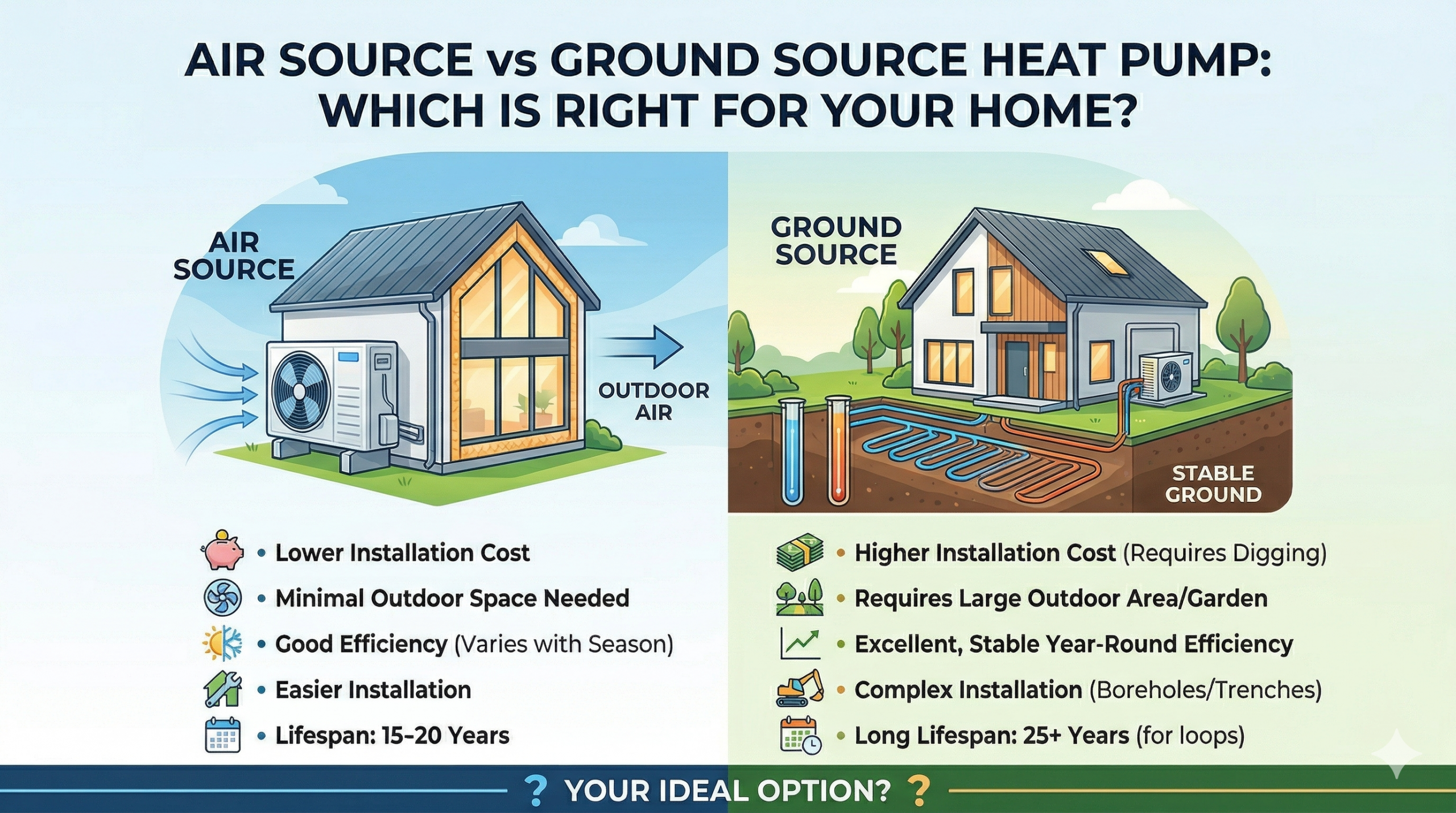
Both types of heat pump do the same job in broad terms: they take warmth from the environment and use it to heat your home without burning anything. Air source pulls from the air outside. Ground source pulls from the soil below your garden. That difference in where they get their heat shapes everything else about them, including what they cost, how long they take to install, and whether your property can take one at all.
For most people reading this in the West Midlands or surrounding areas, the answer is probably an air source heat pump. Not because ground source is bad. It is not. But because it has requirements that most UK properties simply cannot meet. This guide works through those differences properly so you can see which side of the line you fall on.
What each system actually does
Air source heat pump
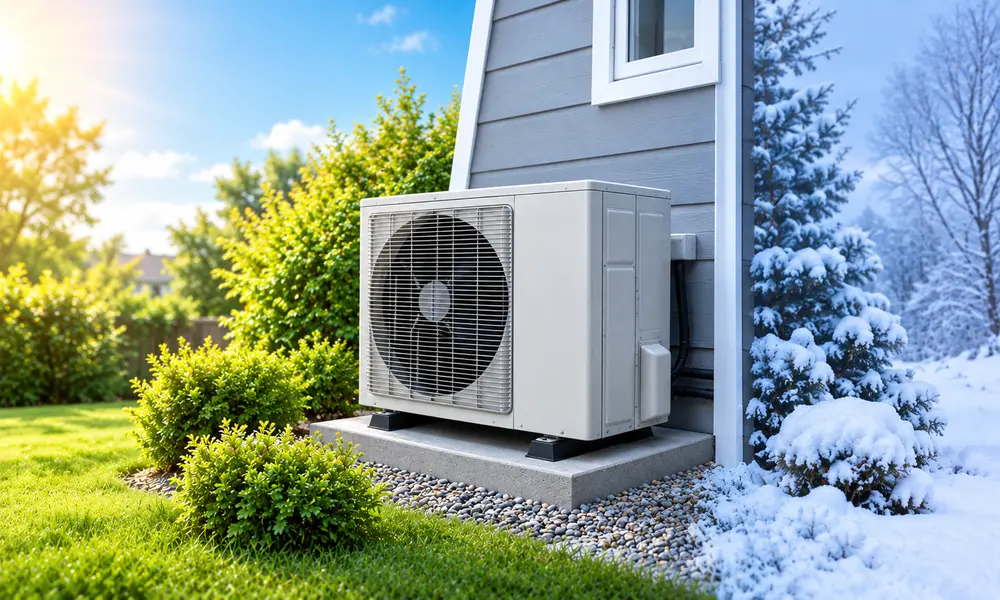
A fan unit sits outside the building, fixed to a wall or placed on a pad beside the house. It pulls in outside air and passes it across metal fins. Even cold air carries thermal energy. The system extracts that energy, concentrates it using a refrigerant and compressor, and moves it into your home as heat.
Inside, it connects to your radiators and a hot water cylinder the same way a boiler would. Day to day, you use it the same way. Set a temperature, the house heats up.
Our full guide on how air source heat pumps work covers each stage of the process in detail.
Ground source heat pump
Instead of the air, a GSHP draws on heat stored underground. A network of pipes, filled with a water and antifreeze mix, gets laid in the garden or drilled vertically into the earth. Below the frost line, ground temperature holds steady at roughly 10 to 13 degrees Celsius all year. That stability is the system’s main advantage over air source.
The indoor unit is compact, something like a large fridge freezer, and fits in a utility room. Getting the pipes in the ground is where the time, disruption, and cost all accumulate.
The numbers side by side
Figures based on UK averages. Your costs depend on property size, insulation level, and whether a borehole is needed.
| Air source (ASHP) | Ground source (GSHP) | |
| Installation cost | £8,000 to £15,000 | £20,000 to £45,000 |
| After £7,500 BUS grant | £500 to £7,500 | £12,500 to £37,500 |
| Typical COP | 2.5 to 4.0 | 3.0 to 4.5 |
| Space needed | Small outdoor area | Large garden or borehole |
| Installation time | 2 to 3 days | 1 to 2 weeks |
| Planning permission | Usually not needed | Sometimes needed |
| Suitable for flats/terraces | Yes | Rarely |
| Cold weather efficiency | Dips slightly below -10C | Stable year-round |
| Lifespan | 20 to 25 years | 25 years or more |
| Maintenance | Annual service | Annual service |
Efficiency: how big is the gap really?
Ground source is more efficient. That is not in dispute. The question is how much it matters in practice.
Underground temperatures do not change with the seasons. Air temperatures do. On the coldest days of a UK winter, when your heating is working hardest, an air source heat pump is pulling from colder air and has to work harder to produce the same amount of heat. A ground source pump faces no such variation.
The numbers from Which? put a typical ASHP at 280 to 380 percent efficiency and a GSHP at 320 to 420 percent. So yes, ground source is better. The gap in real annual bills is usually somewhere between 10 and 20 percent.
What softens this considerably is the UK climate. England does not get the kind of sustained deep cold that would push an ASHP into genuinely poor efficiency territory. A few weeks a year, perhaps. The rest of the heating season, the gap between the two systems is fairly small.
At -10C, a decent ASHP still produces around 2.5 units of heat per unit of electricity. A gas boiler converts about 90 percent of its fuel at best. The heat pump is still well ahead of the boiler even at its winter low.
Cost: where most people make up their mind
Air source installations in the UK run from roughly £8,000 to £15,000 before any grant. Ground source starts at around £20,000 and can reach £45,000 or more when a borehole is needed rather than a horizontal ground loop.
Both qualify for the £7,500 Boiler Upgrade Scheme grant. After that grant, a smaller ASHP installation can come in below £1,000. A GSHP after the same grant still costs £12,500 at minimum, and often a great deal more.
That is a substantial gap. And it does not close quickly through lower running costs. The energy saving from choosing ground source over air source might be a few hundred pounds a year. At that rate, the additional upfront cost takes a very long time to recover.
The Energy Saving Trust confirms both pump types receive the same £7,500 grant. The relative affordability of air source only widens once that is factored in.
Space: the factor that rules out ground source for most UK homes
This is probably the most underappreciated part of the decision.
A horizontal ground loop needs roughly 1.5 to 2 times the floor area of the property in clear, unobstructed garden. For a standard three-bedroom semi-detached, that is 200 to 300 square metres. No trees over the pipes. No outbuildings. No services running through. Most UK gardens, particularly in towns and cities, cannot offer that.
Boreholes are the alternative when space is tight. The pipes go down vertically rather than spreading horizontally. Problem is, each metre of drilling costs £1,000 to £1,500, heavy equipment has to get to the site, and the process takes days. Boreholes make ground source more accessible but push the cost up further.
An air source unit needs a clear metre around it for airflow and a solid wall or ground pad to fix to. That is all. It works on a terrace with a small yard. It works on the side of a semi. It even works for ground floor flats with outdoor access, in many cases.
For a lot of West Midlands properties, particularly in Birmingham suburbs and towns like Bromsgrove and Redditch, the garden simply is not big enough for a GSHP and a borehole is not worth the cost. That settles it.
Running costs: does ground source pay back over time?
It can, over a long enough period. The higher COP means lower electricity use per unit of heat, which adds up across years of bills.
Whether it adds up to more than the extra installation cost is the real question. If you plan to sell within ten years, probably not. The lower upfront spend on an ASHP means you recover your investment faster, and both systems add broadly similar value to a property’s EPC rating and resale appeal.
If you are staying put for twenty years or more, live somewhere that gets colder winters, and have the garden for it, ground source can make sense financially. Ground loops themselves are designed to last fifty to a hundred years. The indoor unit needs replacing at the twenty to twenty-five year mark, same as an air source system.
What installation actually looks like
Air source: two to three days, a small team, one outdoor unit getting fixed in place, pipework connecting inside to the existing system, a hot water cylinder going into a cupboard or utility room. Most households barely notice it happening.
Ground source: specialist groundwork contractors arrive first. Excavation for a horizontal loop takes several days. The garden gets dug up, pipes get laid, the ground gets reinstated. That takes time to recover. If it is a borehole, a drilling rig comes to site. The indoor installation follows after all that. The whole project can run two weeks or more.
For someone who wants their heating sorted and their life back to normal quickly, air source wins this comparison without argument.
So which one is actually right for your home?
For the majority of UK homeowners, air source. Not because it is technically superior. Ground source is more efficient and will produce lower bills over a long timeframe. But efficiency only matters if the system is feasible in the first place, and for most properties it is not.
Air source is probably right for you if:
• Your garden is small or shared
• You live in a terraced house, flat, or semi with limited outdoor space
• Budget after the grant is under £15,000
• You want the installation done quickly with minimal disruption to the property
• You are replacing a gas or oil boiler in an existing home rather than building new
• There is a chance you will move within the next ten years
Ground source is worth looking at if:
• You own a larger rural or semi-rural property with plenty of clear garden
• You are building a new home or doing a substantial renovation where groundworks fit naturally into the project
• You are confident you will stay in the property for twenty years or more
• You are in a part of the UK that regularly sees cold winters
What the government currently offers
The Boiler Upgrade Scheme pays £7,500 toward either type of heat pump in England and Wales. The money goes to the installer and comes off your bill. You do not see it or handle it.
To be eligible, the property needs a valid EPC with no outstanding recommendations for loft or cavity wall insulation. The installer must hold MCS certification. Wunergy is MCS certified and submits the grant paperwork on your behalf.
Sort the insulation first
Neither type of heat pump does well in a poorly insulated house. Both run at lower flow temperatures than a gas boiler, so the building needs to hold heat. If your loft insulation is thin or your cavity walls are unfilled, that is worth dealing with before any heat pump goes in.
A Wunergy surveyor looks at insulation as part of the free home survey and will tell you plainly what needs doing and what does not.
Questions we get asked
Is the extra cost of ground source worth it?
For most UK homeowners, no. The efficiency is genuinely better but the installation premium is large, and the annual saving takes many years to recover. The exception is a large rural property where the land is available and the owners are in for the long haul.
Can I get the grant for both?
Yes. The Boiler Upgrade Scheme offers the same £7,500 for both air source and ground source in England and Wales.
Which runs quieter?
Ground source, because the working parts are underground or inside. Air source units generate some noise, typically in the low 40s of decibels, similar to a quiet conversation in the same room. Modern units are considerably quieter than anything installed ten years ago.
Do I need planning permission?
For air source, usually not. It falls under permitted development in most cases in England as long as the unit meets size and siting rules. Ground source sometimes requires permission, particularly in conservation areas. Your installer will check what applies to your specific address.
Which one adds more to house value?
Both improve the EPC rating and move the property away from gas dependency, which buyers increasingly value. The uplift is broadly similar for either type. An ASHP may actually be viewed more positively by buyers simply because it is more familiar and easier to understand.
I genuinely do not know which suits my home. What now?
Book a free survey. A Wunergy engineer visits the property, looks at the space, checks the insulation, reviews the existing heating setup, and gives you a straight answer. No pressure, no commitment.