
Why Are UK Energy Bills So High and How Can You Reduce Them?
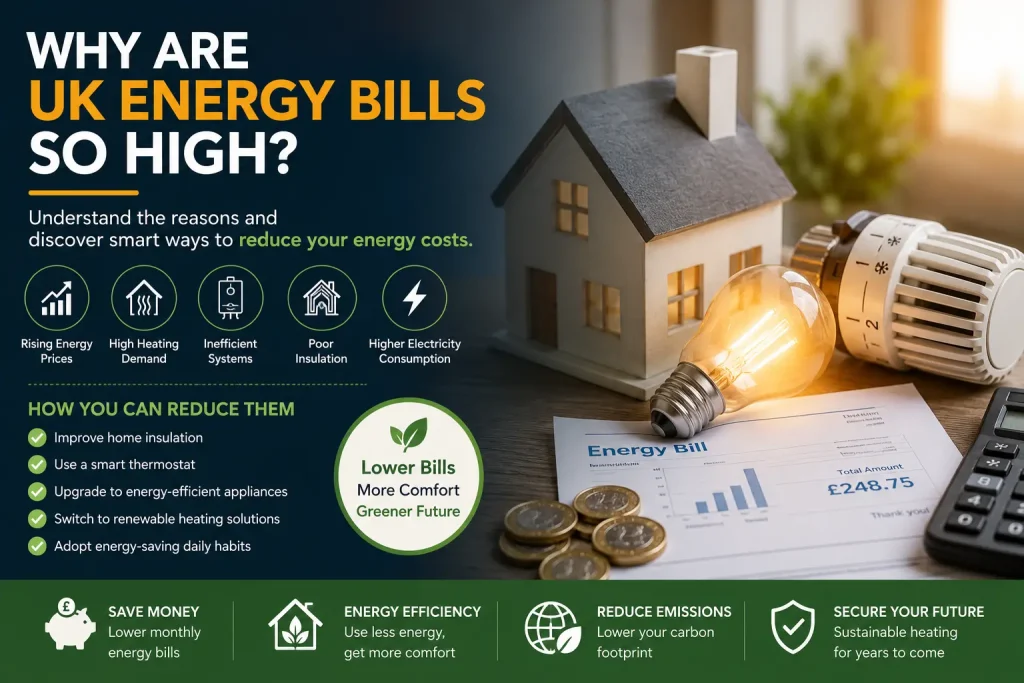
Energy bills have become one of the biggest financial concerns for households across the United Kingdom. Whether you live in a small apartment, a family home, or a larger property, you’ve likely noticed that the cost of heating and powering your home has increased significantly over the past few years. Many homeowners wonder why these costs continue to rise and, more importantly, what they can do to reduce them. The good news is that while some factors affecting energy prices are beyond your control, there are many practical steps you can take to lower your monthly bills. From improving your home’s insulation to upgrading to renewable heating systems like air source heat pumps, investing in energy efficiency can lead to long-term savings while making your home more comfortable and environmentally friendly. Understanding Why UK Energy Bills Keep Rising Energy prices are influenced by a combination of global markets, government policies, infrastructure costs, and household energy consumption. Although energy suppliers set tariffs, many external factors contribute to the amount homeowners ultimately pay. Rising Wholesale Energy Prices One of the biggest drivers of higher energy bills is the increase in wholesale energy prices. Energy suppliers purchase electricity and gas from national and international markets before supplying them to homes and businesses. When demand increases or supply becomes limited, wholesale prices rise. Suppliers then pass these increased costs on to consumers through higher tariffs. Several global events have contributed to recent price increases, including: Although wholesale prices may fluctuate over time, they remain one of the largest contributors to household energy costs. Increased Dependence on Heating During Winter The UK’s climate means that heating systems are used for several months each year. During autumn and winter, households consume considerably more gas or electricity to maintain comfortable indoor temperatures. Common winter energy demands include: Homes with poor insulation require even more energy because heat escapes quickly through walls, roofs, windows, and floors. Older Heating Systems Waste Energy Many UK homes still rely on ageing gas boilers that operate far less efficiently than modern heating systems. Older boilers often: Replacing an outdated heating system with a modern renewable alternative can significantly reduce annual heating costs. Poor Home Insulation One of the biggest hidden causes of expensive energy bills is poor insulation. Even the most efficient heating system struggles when heat constantly escapes from the property. Common areas where heat is lost include: Improving insulation helps your heating system work more efficiently because it retains warmth for longer periods. Higher Electricity Demand Modern homes contain more electrical devices than ever before. Everyday appliances include: Although individual devices may not consume much electricity, their combined energy usage throughout the day contributes significantly to monthly bills. Inflation and Infrastructure Costs Energy suppliers must also invest in maintaining and improving national infrastructure. Costs include: Some of these costs are reflected in household energy tariffs. Why Energy Efficiency Matters More Than Ever Energy efficiency is no longer simply about saving money. Modern homeowners are increasingly looking for ways to: Small improvements made today can generate significant savings over the coming years. Simple Changes That Can Reduce Your Energy Bills Many homeowners assume reducing energy bills requires major renovations. While larger upgrades certainly help, smaller everyday changes also make a noticeable difference. Turn Off Unused Appliances Many electronic devices continue consuming electricity even when not actively being used. Examples include: Switching appliances off completely rather than leaving them on standby can reduce unnecessary electricity consumption. Use LED Lighting Replacing traditional bulbs with LED lighting is one of the easiest ways to reduce electricity usage. LED bulbs: Over time, these savings can add up across an entire household. Install a Smart Thermostat Smart heating controls allow homeowners to better manage when and how their heating system operates. Benefits include: Rather than heating an empty house, smart thermostats ensure energy is only used when needed.
The Future of Home Heating, Why Heat Pumps Are Replacing Boilers
The way we heat our homes is changing rapidly. For decades, gas boilers have been the standard heating solution for millions of households across the UK. While boilers have served homeowners well, rising energy costs, growing environmental concerns, and advancements in renewable technology are driving a major shift in the heating industry. Air source heat pumps are emerging as the preferred alternative, offering greater efficiency, lower carbon emissions, and long-term savings. As the UK moves towards a greener future, more homeowners are considering heat pumps as a practical replacement for traditional boilers. With government incentives such as the Boiler Upgrade Scheme and increasing awareness of sustainable living, the transition is gaining momentum. Understanding why heat pumps are replacing boilers can help homeowners make informed decisions about their future heating needs. Understanding Traditional Boilers Traditional gas boilers generate heat by burning natural gas. This heat is then transferred through radiators or underfloor heating systems to warm the home and provide hot water. While modern condensing boilers are more efficient than older models, they still rely on fossil fuels and produce carbon emissions. Boilers typically operate at efficiencies between 85% and 95%, meaning some energy is always lost during the heating process. In addition, fluctuations in gas prices can significantly impact household energy bills. As environmental regulations become stricter and the UK works towards reducing its carbon footprint, the limitations of gas boilers are becoming increasingly apparent. What Is an Air Source Heat Pump? An air source heat pump is a renewable heating system that extracts heat from the outside air and transfers it into your home. Unlike a boiler, which creates heat by burning fuel, a heat pump moves existing heat from one place to another. Even when outdoor temperatures are low, there is still thermal energy present in the air. Heat pumps capture this energy using a refrigerant cycle and then increase its temperature through compression. The resulting heat is used to provide space heating and hot water for the home. This innovative approach allows heat pumps to achieve efficiency levels that far exceed traditional heating systems. Why Heat Pumps Are Becoming the Preferred Choice Exceptional Energy Efficiency One of the biggest advantages of heat pumps is their remarkable efficiency. While a boiler can never exceed 100% efficiency because it burns fuel, heat pumps can achieve efficiencies of over 300%. This means that for every unit of electricity consumed, a heat pump can produce three to four units of usable heat. This superior performance can lead to significant reductions in energy consumption and lower heating costs over time. Reduced Carbon Emissions Environmental concerns are playing a major role in the shift away from gas boilers. Heating accounts for a substantial portion of household carbon emissions in the UK. Heat pumps produce far fewer emissions because they do not burn fossil fuels. When powered by renewable electricity sources such as wind or solar energy, their environmental impact becomes even smaller. This makes heat pumps an important part of the UK’s strategy to achieve net-zero carbon emissions. Long-Term Cost Savings Although the upfront installation cost of a heat pump may be higher than that of a boiler, the long-term financial benefits can be substantial. Heat pumps consume less energy to produce the same amount of heat, helping homeowners reduce their monthly utility bills. Combined with available government grants, the investment becomes more affordable and attractive. As energy prices continue to fluctuate, homeowners are increasingly seeking efficient systems that provide predictable operating costs and long-term value. Government Support and Incentives The UK government actively supports the adoption of renewable heating technologies through initiatives such as the Boiler Upgrade Scheme. Eligible homeowners can receive grants of up to £7,500 towards the cost of installing an air source heat pump. These incentives significantly reduce the financial barrier to upgrading from a traditional boiler and encourage wider adoption of sustainable heating solutions. Government support reflects the growing recognition that heat pumps are a critical component of the nation’s energy transition. Comparing Heat Pumps and Boilers Efficiency Heat pumps generally achieve efficiencies exceeding 300%, while even the most efficient boilers operate below 100%. Environmental Impact Heat pumps produce significantly lower carbon emissions because they use renewable heat from the environment rather than burning gas. Running Costs In many cases, homeowners can lower their annual heating expenses through the use of an energy-efficient heat pump system. Maintenance Requirements Heat pumps typically require less maintenance than gas boilers because they have fewer moving parts and no combustion process. Lifespan A well-maintained air source heat pump can last 15 to 20 years or more, often exceeding the lifespan of traditional boilers. The Role of Heat Pumps in Net Zero Homes As building regulations evolve, new homes are increasingly designed with sustainability in mind. Heat pumps play a central role in creating energy-efficient, low-carbon properties. Many modern homes are built with enhanced insulation, underfloor heating, and smart energy management systems that work perfectly alongside heat pump technology. These features maximize efficiency and help homeowners achieve lower energy consumption. The integration of heat pumps into new-build developments demonstrates how the future of home heating is shifting away from fossil fuels and towards renewable energy solutions. Common Misconceptions About Heat Pumps Heat Pumps Do Not Work in Cold Weather This is one of the most common myths. Modern air source heat pumps are specifically designed to operate efficiently even in freezing temperatures. Many systems continue to perform effectively in temperatures as low as -25°C. Heat Pumps Are Noisy Today’s heat pumps are engineered with advanced sound reduction technology. Most operate quietly and produce noise levels comparable to everyday household appliances. Heat Pumps Cannot Heat Large Homes Heat pumps are available in a wide range of capacities suitable for properties of all sizes, from small terraced houses to large detached homes. Heat Pumps Are Too Expensive Government grants and lower operating costs have made heat pumps increasingly affordable. Many homeowners find that the long-term savings outweigh the initial investment. Smart Technology and the
Air source vs ground source heat pump: which is right for your home?
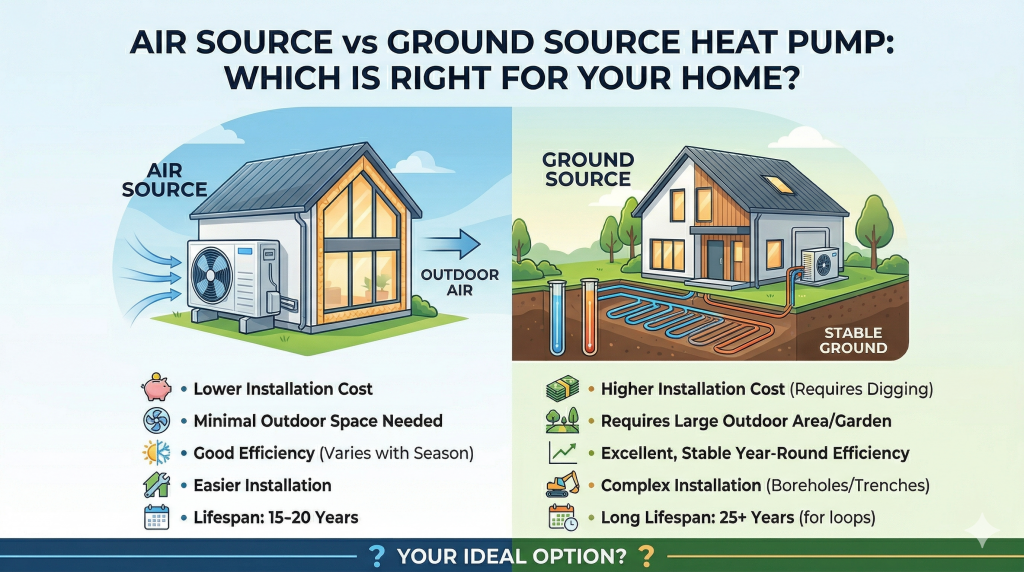
People ask this a lot. Usually after a neighbour gets one installed or after opening an energy bill that has gone up again. Both types of heat pump do the same job in broad terms: they take warmth from the environment and use it to heat your home without burning anything. Air source pulls from the air outside. Ground source pulls from the soil below your garden. That difference in where they get their heat shapes everything else about them, including what they cost, how long they take to install, and whether your property can take one at all. For most people reading this in the West Midlands or surrounding areas, the answer is probably an air source heat pump. Not because ground source is bad. It is not. But because it has requirements that most UK properties simply cannot meet. This guide works through those differences properly so you can see which side of the line you fall on. What each system actually does Air source heat pump A fan unit sits outside the building, fixed to a wall or placed on a pad beside the house. It pulls in outside air and passes it across metal fins. Even cold air carries thermal energy. The system extracts that energy, concentrates it using a refrigerant and compressor, and moves it into your home as heat. Inside, it connects to your radiators and a hot water cylinder the same way a boiler would. Day to day, you use it the same way. Set a temperature, the house heats up. Our full guide on how air source heat pumps work covers each stage of the process in detail. Ground source heat pump Instead of the air, a GSHP draws on heat stored underground. A network of pipes, filled with a water and antifreeze mix, gets laid in the garden or drilled vertically into the earth. Below the frost line, ground temperature holds steady at roughly 10 to 13 degrees Celsius all year. That stability is the system’s main advantage over air source. The indoor unit is compact, something like a large fridge freezer, and fits in a utility room. Getting the pipes in the ground is where the time, disruption, and cost all accumulate. The numbers side by side Figures based on UK averages. Your costs depend on property size, insulation level, and whether a borehole is needed. Air source (ASHP) Ground source (GSHP) Installation cost £8,000 to £15,000 £20,000 to £45,000 After £7,500 BUS grant £500 to £7,500 £12,500 to £37,500 Typical COP 2.5 to 4.0 3.0 to 4.5 Space needed Small outdoor area Large garden or borehole Installation time 2 to 3 days 1 to 2 weeks Planning permission Usually not needed Sometimes needed Suitable for flats/terraces Yes Rarely Cold weather efficiency Dips slightly below -10C Stable year-round Lifespan 20 to 25 years 25 years or more Maintenance Annual service Annual service Efficiency: how big is the gap really? Ground source is more efficient. That is not in dispute. The question is how much it matters in practice. Underground temperatures do not change with the seasons. Air temperatures do. On the coldest days of a UK winter, when your heating is working hardest, an air source heat pump is pulling from colder air and has to work harder to produce the same amount of heat. A ground source pump faces no such variation. The numbers from Which? put a typical ASHP at 280 to 380 percent efficiency and a GSHP at 320 to 420 percent. So yes, ground source is better. The gap in real annual bills is usually somewhere between 10 and 20 percent. What softens this considerably is the UK climate. England does not get the kind of sustained deep cold that would push an ASHP into genuinely poor efficiency territory. A few weeks a year, perhaps. The rest of the heating season, the gap between the two systems is fairly small. At -10C, a decent ASHP still produces around 2.5 units of heat per unit of electricity. A gas boiler converts about 90 percent of its fuel at best. The heat pump is still well ahead of the boiler even at its winter low. Cost: where most people make up their mind Air source installations in the UK run from roughly £8,000 to £15,000 before any grant. Ground source starts at around £20,000 and can reach £45,000 or more when a borehole is needed rather than a horizontal ground loop. Both qualify for the £7,500 Boiler Upgrade Scheme grant. After that grant, a smaller ASHP installation can come in below £1,000. A GSHP after the same grant still costs £12,500 at minimum, and often a great deal more. That is a substantial gap. And it does not close quickly through lower running costs. The energy saving from choosing ground source over air source might be a few hundred pounds a year. At that rate, the additional upfront cost takes a very long time to recover. The Energy Saving Trust confirms both pump types receive the same £7,500 grant. The relative affordability of air source only widens once that is factored in. Space: the factor that rules out ground source for most UK homes This is probably the most underappreciated part of the decision. A horizontal ground loop needs roughly 1.5 to 2 times the floor area of the property in clear, unobstructed garden. For a standard three-bedroom semi-detached, that is 200 to 300 square metres. No trees over the pipes. No outbuildings. No services running through. Most UK gardens, particularly in towns and cities, cannot offer that. Boreholes are the alternative when space is tight. The pipes go down vertically rather than spreading horizontally. Problem is, each metre of drilling costs £1,000 to £1,500, heavy equipment has to get to the site, and the process takes days. Boreholes make ground source more accessible but push the cost up further. An air source unit needs a clear metre around it for airflow and a solid wall